


Part 2 of a five-part series on how a child’s faith is actually formed. The first, Your Child’s First Theology Is You, was about your face, and what your child reads in it. This one is about the face you have been reading your whole life, and the God whose face is turned toward you right now. Next up: “Good Enough Is an A.”

In the last article I made a claim that lands on most parents like a loaded barbell across the shoulders before it ever lands like grace: your child’s first picture of God is drawn from your face. Long before they can parse a doctrine, they are learning from the way you look at them whether love is something you keep or something you have to earn back.
But there is a question underneath that one, and it is probably the reason you clicked. Long before you were the face, you were the child looking up at one. You have your own first theology. You learned the character of God from a face too, and you did not get to choose whose.
So this piece is not one more thing to get right for your kid. It is about the face you needed, and whether it is still turned toward you. Received the right way, it is not another weight at all. It is the kind of good news that finally lets you set the weight down and breathe.
We are formed by the faces that meet us
Close your eyes for a second, if you are somewhere you can. Picture a face from your childhood that genuinely lit up when it saw you. Not polite. Not neutral. Glad. A grandparent, a coach, an aunt, someone whose face said, without a word, I am glad you exist.
I do not know if your grandparents were anything like mine. I have amazing grandparents and some of the most beautiful memories from time with them when I was a little boy. My grandparents were the type who reminded you not to tell your parents how much ice cream they let you eat that weekend with a wink and a smile when your parents were getting you back into their car. My maternal grandparents took my Blue Bell addiction to new levels. Honestly, looking back on it? I think they took some pride in how many gallons of vanilla ice cream a fifty-pound eight-year-old could put away in one night under their roof. Even more honesty? They barely had to twist my arm. I was a fanatic.
Regardless, they took their grandparently calling to spoil me via Blue Bell as seriously as any minister has ever taken the gospel. I could put away vanilla until my stomach stuck out like a ten-year-old with a beer belly and a fatty liver, and they would keep scooping until I was nearly sick and even more thrilled about it. My parents were trying to build a little self-discipline into me. My grandparents, with my parents’ permission, were trying to spoil me rotten, and they were very good at their jobs.
I spent summers up at their office. My grandfather owned an architectural and engineering services firm, and they kept a whole floor of their warehouse where a kid could watch TV and get underfoot. I would wander into his workroom in the middle of a workday, and this is the memory my body still keeps: no matter how busy he was, no matter what adult weight he was carrying that day, he would look up from his drafting table and the biggest smile I have ever seen on a human face would break across his. In that half a second I knew I was seen, I was wanted, I belonged. It cost him nothing. It gave me everything.
Here is what it took me years and a stack of attachment research to understand: that smile was not just sweet. It was doing something. Joy, it turns out, is relational. It is not mainly a mood you talk yourself into on your own. It is what happens when you catch the delight on someone’s face, and receive the delight they take in you, and hand some back. My grandfather looking up from that drafting table was, in the most literal sense, teaching my nervous system what joy is.
My grandmother, showing me all the ice cream bowls she had cleaned and stacked away for me before my weekend sleepover, taught my soul that I was known and would be provided for.
And my paternal grandparents, who folded my sister and me into decades of inside jokes and once took us on the great grandparent-grandkid pilgrimage to Branson, Missouri (the Vegas of grandparent-grandchild vacation destinations), wired my nervous system to know that I belonged to a people, and to a people who knew love and joy.
Maybe a face like that came to you the moment I asked. Maybe you had to reach back years to find one. And maybe no face came at all, and the reaching has its own ache, and I am not going to rush you past that or tie it off with a blessing and move on. That ache is the exact place the rest of this is trying to reach.
Because that is not a sentimental memory. That is your nervous system telling you the truth about how you were built. A caregiver’s face, their eyes, their tone, is the first thing an infant uses to answer the questions every one of us is still quietly asking in a hard room: Am I safe here? Am I seen? Do I belong? We are formed, from the very beginning, by the faces that turn toward us and the faces that turn away.
Two faces in the oldest blessing we have
Now listen to the oldest blessing the people of God ever carried, from Numbers 6. Archaeologists found a version of it scratched onto two little silver scrolls near Jerusalem, older than the Dead Sea Scrolls by roughly five centuries. People wore these words against their skin.
The LORD bless you and keep you;
the LORD make his face shine on you and be gracious to you;
the LORD turn his face toward you and give you peace.
Notice how much of that blessing is about a face. God’s face, twice.
Cyd and Geoff Holsclaw, in Landscapes of the Soul (Tyndale, 2025), one of the best books I have read on the science and the spirituality of attachment, make a point about those two lines that I have not been able to put down. (They also walk through this exact material on their Attaching to God podcast, in an episode titled “What If God Actually Likes You?” It is worth twenty-six minutes of your commute.) Drawing on attachment research, they argue that our deepest relational need, what they call joyful connection, comes in two movements, and that both of them are sitting right here in the blessing.
The first movement is the shining face. The LORD make his face shine on you. This is the face of delight, eyes dancing, glad to be with you. The Holsclaws call the felt version of this “emotional caffeine,” the face-to-face loop between a caregiver and a child that grows the capacity for joy itself. It is not transactional. It is not a reward for a good week. It is a face that lights up because you walked in.
The second movement is the turning face. The LORD turn his face toward you and give you peace. This is the face that finds you when you are overwhelmed, ashamed, exhausted, hiding. The Holsclaws call this “returning to joy,” the attuned face that meets you in distress and helps you come back. Attachment researchers would call it the safe haven: not the relationship you explore from, but the one you return to when it has all gone wrong.
Here is why I think this matters for anyone carrying an anxious or despairing mind. When we are overwhelmed, our nervous system drops into what the Holsclaws call protection mode, the fight, flight, freeze, or shutdown state. And in that state we are certain that every face has turned away. That is not a spiritual failure. That is a nervous system doing its job with an old and incomplete map of who is safe. And the blessing of Numbers 6 is not spoken to the version of you who has it together. It is aimed straight at the version of you in protection mode. God’s peace, the blessing says, does not come from everything being okay. It comes from a face that stays.
Which face did you learn on God?
Here is the pattern the whole series turns on. We do not learn the character of God first from sermons. We learn it from what it felt like to need someone. And then, later, we hand God that same face.
So if the face you learned on was mostly disappointed, you will hand God a disappointed face. If the face went warm when you performed and quiet when you struggled, you will assume God’s face works the same way, shining when you are doing well and turning away the moment you are not. If the face was rarely there at all, you will suspect, underneath everything you say you believe, that God is also somewhere else, busy, and that you are mostly an obligation.
This is the quiet ache the blessing is aimed at. For the reader who never had a face light up at them, the promise of Numbers 6 is not a generic “God loves you.” It is specific. It is a countenance, turned toward you, on purpose. The Holsclaws land this exactly where the mental-health-and-faith conversation needs it to land: no matter what your early life was like, joy is still available in the face of God turned toward you. And they route the peace of that turning face through Jesus specifically, tying it to Paul’s line in Philippians about the peace that Jesus came to offer, the peace that guards your heart in Christ Jesus.
Your love for God will never outrun your picture of him.
And a lot of us are spending our whole lives trying to love a face that was never his. We are flinching from a God assembled out of the people who first failed us, certain there is some colder, truer face behind the kind one. The theologian T. F. Torrance said it about as bluntly as it can be said: there is no God behind the back of Jesus Christ. No hidden face, no disappointed one waiting in the shadows, no God whose real disposition is different from the face that has already turned all the way toward you in him.
The face has a name, and it is Jesus
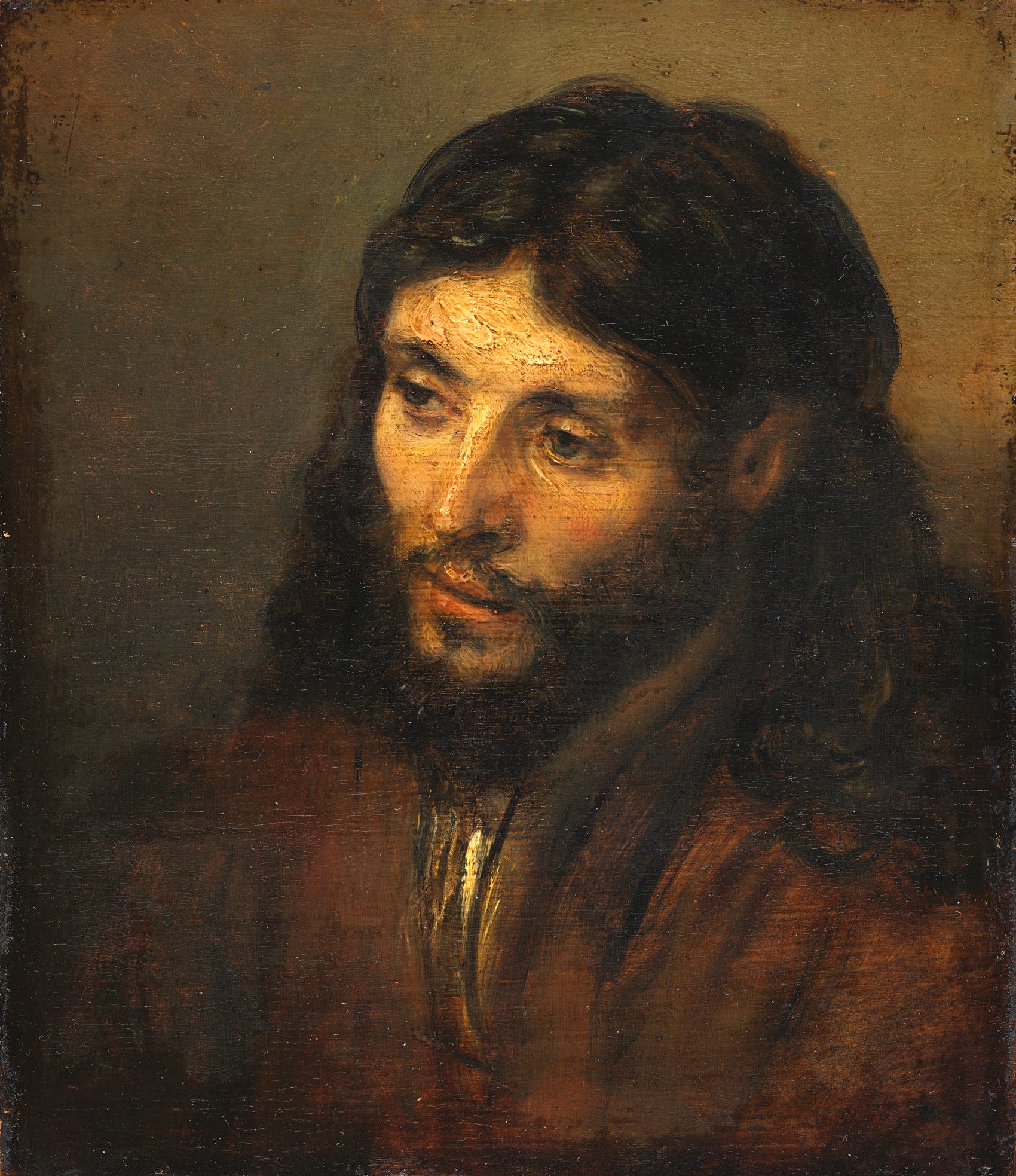
Here is what keeps this from being one more nice idea about God’s kindly presence. The God we are talking about did not stay a shining face in the safe distance of heaven. In Jesus, the face turned all the way toward us and came into the room.
The historic claim of the church is not simply that Jesus is like God. It is that God is like Jesus. So when I ask what God’s face is actually doing toward you right now, I am not guessing at a mood behind the clouds. I am looking at Jesus. And the face of Jesus does not go quiet when you fall apart. It is the face that turned toward tax collectors and lepers and the ones everyone else had learned to look past. It is the face that wept at a friend’s grave before it did anything useful about it. It is, at the very end, a face on a cross, turned toward the people driving the nails, still not looking away.
That is the turning face of Numbers 6, made flesh. The God we know in Jesus is not the disappointed parent you have been flinching from. He is the one whose defining move, over and over, is to turn his face toward the exact place you were sure he had left.
You can behold a face like that. And it turns out beholding is the whole point.
Some of the most spiritual work you will do is letting God look at you
The oldest Christian instinct about prayer is not that it starts with talking. It starts with being sought, and then with looking back. The Psalmist does not open with a request; he answers a summons about a face: You have said, Seek my face. My heart says to you, Your face, LORD, do I seek (Psalm 27:8). Hans Urs von Balthasar, in his small book simply called Prayer, described contemplation as learning to gaze on the face of God, to behold him before you have achieved anything for him. Spiritual formation, in that light, does not begin with doing more. It begins with receiving who God is toward you.
And what we behold is what we become. If the face you imagine God having is cold, evaluating, perpetually disappointed, that face will quietly form the way you carry yourself, and the way your own face meets your kids across the kitchen table. But if the face you receive is shining and turned toward you, delighting in you, steady with you when you are not steady at all, a different presence starts to form in you. You cannot give your children a face you have never received. This is the deepest reason the last piece was not one more thing to perform. You do not manufacture a warm face for your kid by trying harder. You catch it, from a God whose face is already turned toward you.
So let me hand you the same three small invitations I once handed a room full of exhausted people, adapted for wherever you are tonight.
First, the shining face. Sometime this week, before the emails, before the noise, sit still for sixty seconds and let God look at you with delight instead of with a checklist. Pray the old words as if they were spoken to you and not achieved by you: Lord, make your face shine on me. You are not performing. You are receiving.
Second, the turning face. When you hit protection mode, when the shame spins up and every face feels turned away, do not try to think your way out of it first. Take one slow breath and pray the smaller, truer prayer: Turn your face toward me. Let your nervous system borrow the steadiness of a God who is not going anywhere.
Third, the face you carry. Ask who needs your face to be a blessing this week. Not fixing them. Not correcting them. Simply being glad they exist, the way somebody was once glad you did. It costs almost nothing to turn your face toward someone. It can change the weather of their whole day.
The blessing, again
God’s blessing is not first a task list. It is a face. A shining face that delights in you before you have done anything to deserve it. A turning face that finds you when you are overwhelmed and will not look away. And in Jesus, that face has crossed the distance, taken on skin, and turned all the way toward you, even into the dark.
You have been reading faces your whole life to learn what God is like.
Let this be the one you read now.
For some of you, I know that is not a small ask. The face you learned on did not shine, or it left, or it turned on you, and being told God’s face is different can feel like being handed a promise in a language your body never learned. I am not going to paper over that with a blessing and move on. It is the next thing this series owes you, and it is where we are going: what the God we know in Jesus does with a mirror that was cracked from the start.
May the Lord bless you and keep you.
May the Lord make his face shine on you and be gracious to you.
May the Lord turn his face toward you and give you peace.
I Want To Hear From You!
This post opens with a question, and I actually want to ask it:
Whose face lit up when you walked into the room ?
Or did you have to reach for one, and come up empty?
Notes, credit, and a few rabbit holes
A word before you skim this part. I am a theology nerd, and I would rather over-credit the people I am building on than pretend I arrived at any of this by myself. So treat what follows as part footnote, part reading list, for anyone who wants to keep pulling the thread.
The heart of this piece, the two movements of God’s face and the reading of Numbers 6 as a double face-blessing, is not mine. It comes from Cyd and Geoff Holsclaw (PhD), Landscapes of the Soul (Tyndale, 2025), from their chapter “One Desire: Joyful Connection.” The terms “joyful connection,” “emotional caffeine,” “returning to joy,” and “protection mode” are theirs, and are not standard attachment vocabulary, so I want them plainly credited. If the framework moved you, go to the source. The book is genuinely good, and they teach this same Numbers 6 material on their Attaching to God podcast, in episode 137, "What If God Actually Likes You?" and they also write at Embodied Faith on Substack.
If you want to keep pulling the attachment thread, the science under all of it runs from John Bowlby and Mary Ainsworth through Allan Schore’s work on affect regulation. But if you only read one, read Curt Thompson, either The Soul of Shame or Anatomy of the Soul. He is the most humane bridge I know between the neuroscience and the life of faith.
Two theologians did quiet, load-bearing work here. The line “there is no God behind the back of Jesus Christ” is T. F. Torrance, a sentence he returns to across his work (I first met it in The Mediation of Christ). And the conviction that prayer begins in beholding rather than achieving is Hans Urs von Balthasar’s, from his small book Prayer, which I have read more times than anything else on the subject. On beauty as the thing that reaches us before argument does, David Bentley Hart’s The Beauty of the Infinite, though fair warning, it is a mountain.
One last one, because I cannot help myself. The blessing at the center of this piece is old almost past believing. In 1979, archaeologists near Jerusalem found two tiny silver scrolls, the Ketef Hinnom amulets, with a version of these very words scratched into them. They date to around 600 BC, they sit today in the Israel Museum, and they are among the oldest fragments of the Bible we have, older than the Dead Sea Scrolls by roughly five centuries. People wore this blessing against their skin. I find that unreasonably moving.
This is the second article in this series. Read the first one below. Part 3, “Good Enough Is an A,” is coming next and is about the most freeing truth in all of attachment research.

Mike Skinner is the founder of Cruciform Hope Ministries, where he writes about where mental illness and the Christian faith meet. He has spent nearly two decades in pastoral ministry, currently serves as a chaplain to interdenominational high school students, and holds a Master of Arts in Theological Studies.